The growth of digital businesses has made data management increasingly complex. Applications must be able to handle large transaction volumes, process information quickly, and maintain service availability at all times. These demands require companies to have database infrastructure that is not only reliable but also flexible enough to accommodate business growth.
However, traditional relational databases may not always be able to meet these demands, particularly as data volumes and transaction workloads continue to increase. This is where a database modernization strategy becomes essential. With the right modernization approach, companies can improve database scalability, resilience, and efficiency without compromising business continuity. One technology worth considering is PingCAP's TiDB Distributed SQL.
Challenges of Traditional Databases in the Era of Digital Transactions
Traditional relational databases have long been used in business applications because they offer structured data management and consistent transactions. However, growing user bases and increasing transaction volumes make these architectures increasingly difficult to scale, particularly due to their reliance on a single server and the high costs associated with capacity upgrades.
One of the main challenges is vertical scaling and the complexity of manual sharding. Vertical scaling requires upgrading server specifications, while manual sharding involves managing data distribution and query routing at the application level. Both approaches can increase costs and add complexity to system maintenance.
In addition, database maintenance carries the risk of downtime. Schema updates, large-scale data migrations, and server failures can disrupt transactions and business operations. Therefore, companies need an architecture that supports data replication and recovery mechanisms to maintain service availability.
What Should You Consider Before Choosing Distributed SQL?
Database modernization is not simply about replacing legacy technology with something new. Companies need to ensure that their chosen architecture can handle growing data volumes, increasing transaction workloads, and system consistency and availability requirements. One approach worth considering is Distributed SQL, a technology that combines relational database capabilities, such as SQL and ACID (Atomicity, Consistency, Isolation, Durability) transactions, with a distributed architecture that supports horizontal scalability.
Transaction consistency is particularly important for industries such as banking, e-commerce, and digital services, where data accuracy is essential. In TiDB, the Raft consensus mechanism supports data replication and consistency across nodes, enabling reliable transaction processing in distributed environments.
Companies should also consider analytical processing capabilities. Through its Hybrid Transactional and Analytical Processing (HTAP) approach, TiDB supports both OLTP and OLAP workloads within a single distributed database platform. This allows businesses to perform analytics on relatively up-to-date operational data without always relying on data transfers through ETL (Extract, Transform, Load) processes.
By considering these two aspects, Distributed SQL can be an alternative for companies looking to improve scalability while maintaining transaction consistency. This architecture provides the flexibility to manage growing workloads without having to rely solely on increasing the capacity of a single server.
Key Advantages of TiDB Enterprise for Accelerating Database Modernization
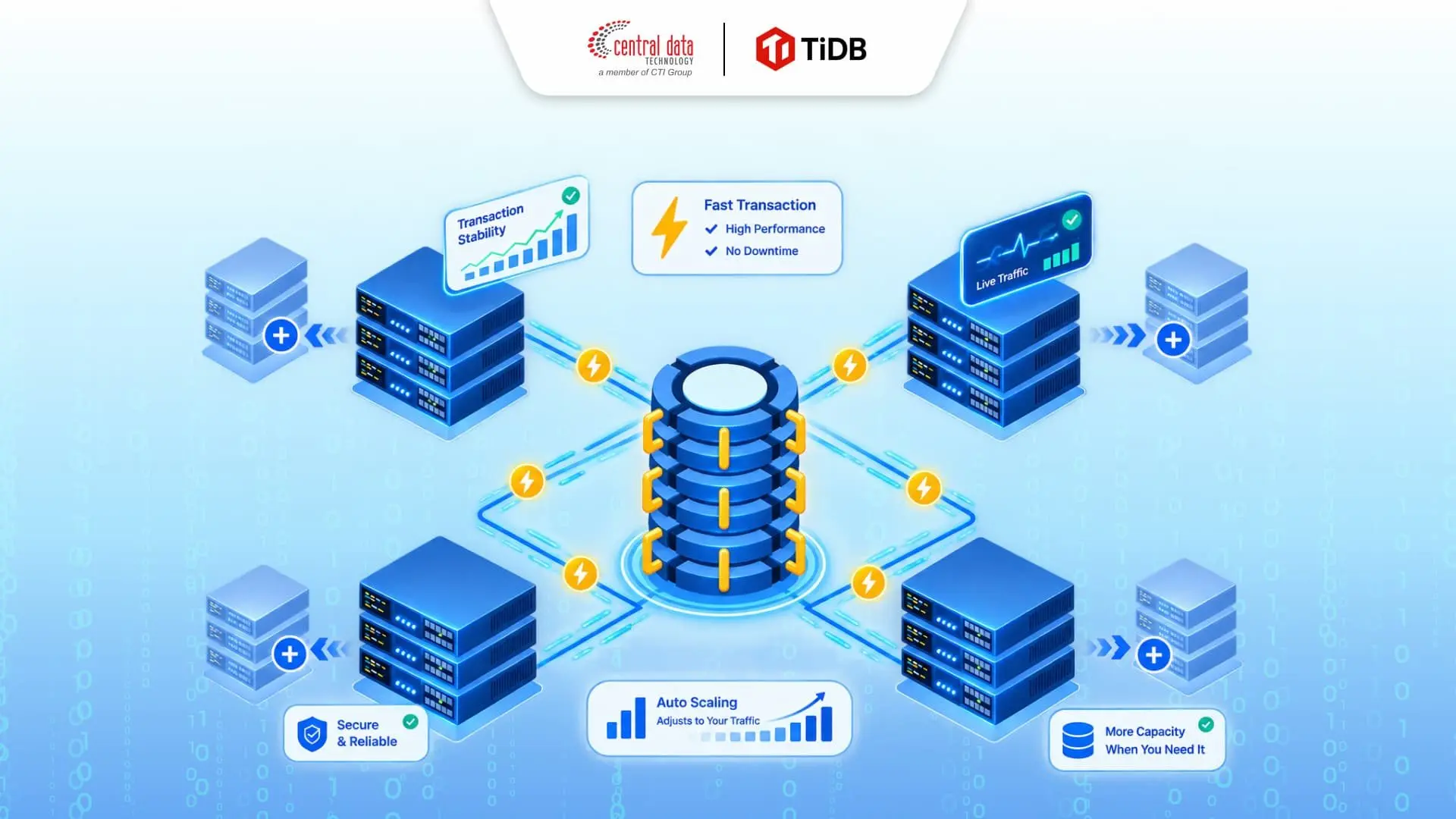
TiDB is a Distributed SQL database from PingCAP, designed to address the needs of modern applications with continuously growing data volumes and transaction workloads. Through its distributed architecture, TiDB combines SQL capabilities with horizontal scalability, transaction consistency, and support for various data processing requirements.
For companies developing a Database Modernization Strategy, TiDB Enterprise offers several capabilities that can help build more flexible and reliable database infrastructure, including:
MySQL Compatibility. Supports the MySQL protocol and various compatibility features to simplify application transitions without necessarily requiring a complete code rewrite.
Horizontal Scalability. Allows companies to expand database capacity by adding more nodes, reducing their reliance on upgrading the specifications of a single server.
Strongly Consistent Distributed Transactions. Supports distributed transactions with strong consistency to maintain data accuracy across all nodes.
High Availability and Automatic Failover. Supports data replication and failover mechanisms to help maintain service availability in the event of node failures.
OLTP, OLAP, and HTAP Support. Enables transaction processing and analytical workloads within a single distributed database architecture.
Flexible Data Migration. Provides TiDB Data Migration (DM) to support full data migration and incremental replication from MySQL-compatible source databases.
Modernizing Databases Without Disrupting Business Operations
Successful database modernization depends not only on technology but also on a well-planned migration strategy. Companies need to ensure that data integrity is maintained, and business operations remain uninterrupted. To support this process, TiDB provides TiDB Data Migration (DM), which supports full data migration and incremental replication from MySQL-compatible source databases.
The first step is to assess and map the database schema to identify table structures, data volumes, transaction patterns, and application dependencies. Companies can then use TiDB DM to migrate initial data and replicate subsequent changes incrementally. This process should be accompanied by source and target data validation, application query testing, and transaction consistency checks to minimize the risk of data inconsistencies during migration.
Beyond technical readiness, companies must also consider data sovereignty and compliance with Indonesian regulations, particularly in the banking and financial services sectors. Factors such as data storage locations, information protection, access management, and audit requirements should be evaluated in accordance with applicable regulations. By considering both technical and regulatory aspects from the outset, companies can carry out database modernization in a more structured and strategic manner.
Frequently Asked Questions About Database Modernization Strategy (FAQ)
1. What Is the Difference Between NoSQL Databases and Distributed SQL Such as TiDB?
NoSQL databases are generally designed around non-relational data models and flexible scalability approaches. Distributed SQL, on the other hand, combines relational database capabilities, SQL support, and strongly consistent transactions within a distributed architecture. TiDB falls into the Distributed SQL category because it supports SQL, distributed transactions, and horizontal scaling.
2. Do MySQL-Based Applications Need to Be Completely Rebuilt When Migrating to TiDB?
Not necessarily. TiDB supports the MySQL protocol and various compatibility features that can help MySQL-based applications adapt to the migration process. However, companies still need to test their database schemas, SQL syntax, database features, and application dependencies to identify any necessary adjustments.
3. How Does TiDB Support HTAP Architecture?
TiDB supports HTAP by combining transactional processing (OLTP) and analytical processing (OLAP) within a single distributed database architecture. This approach allows companies to run analytics on relatively up-to-date operational data without always having to transfer it through ETL pipelines to separate systems.
Also Read: When Migration Alone Is Not Enough: The Rise of Cloud Modernization Services
Modernize Your Enterprise Database Architecture with CDT
As business data volumes and transaction workloads continue to grow, companies need database infrastructure that can keep pace without compromising performance and service availability. Database modernization is an essential step toward overcoming the limitations of conventional architectures while preparing IT infrastructure for increasingly complex business demands.
Through PingCAP's TiDB Enterprise, Central Data Technology (CDT), part of CTI Group, helps companies explore Distributed SQL solutions with horizontal scalability, transaction consistency, and high availability to support database infrastructure modernization.
Contact CDT to explore database management solutions and database modernization strategies tailored to your business needs.
Author: Angela Merici Retna Perwitasari
Content Writer Intern CTI Group