Here is a number worth paying attention to. Hitachi Vantara reports that roughly 50 percent of stored enterprise data is dark data, information that goes unused. The finding comes from a survey of 1,288 IT and C-suite leaders across 12 markets, including Indonesia.
That figure points to a much bigger challenge. Businesses can generate data faster than they can determine its value, where it belongs, and how long it should be retained. As that gap widens, storage fills with poorly understood information while critical data becomes scattered across systems and harder to protect.
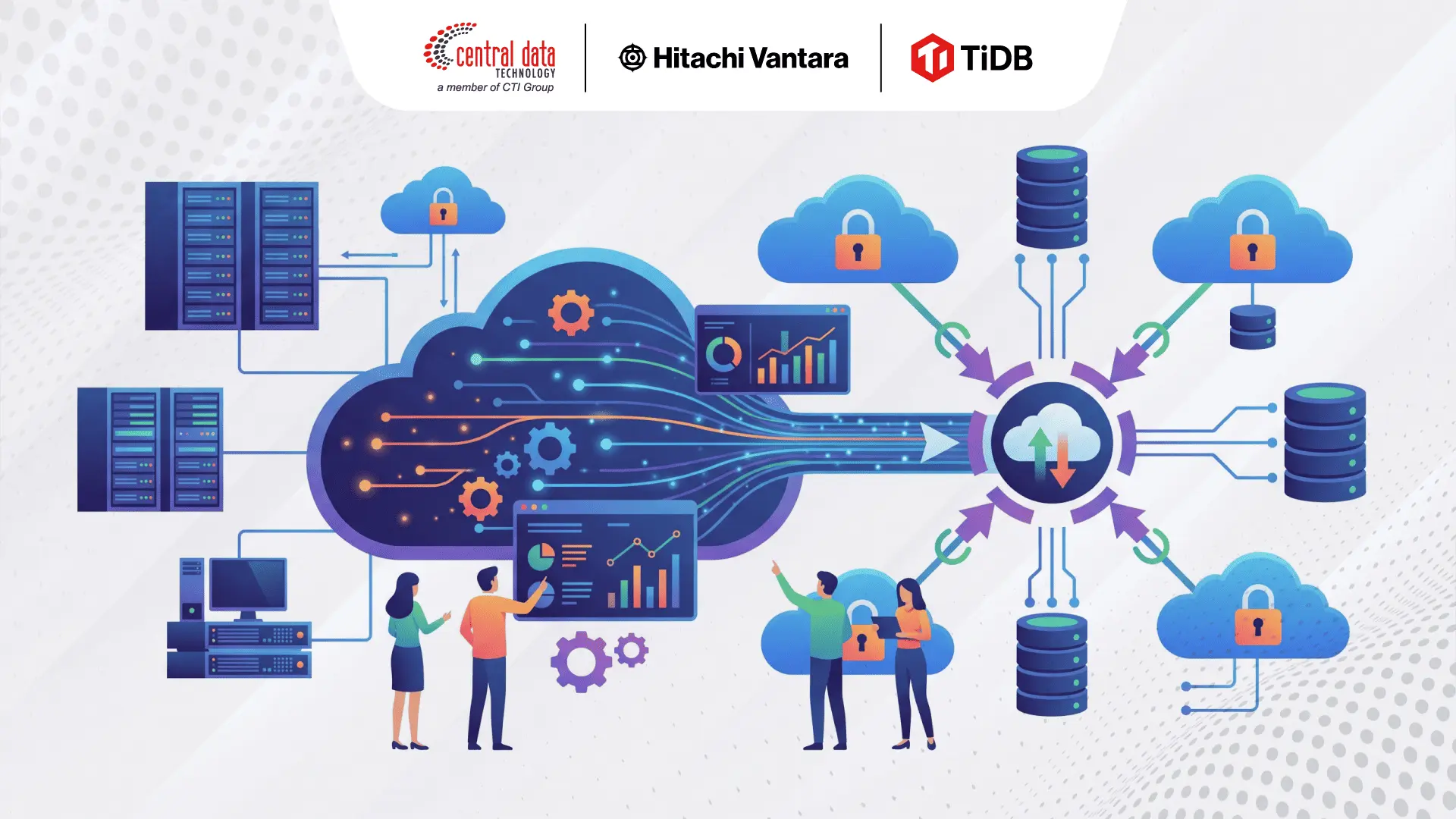
A modern data management strategy closes that gap by connecting how data is placed, protected, and processed throughout its lifecycle. In this article, we will explore three foundations that bring hybrid cloud placement, ransomware recovery, and database modernization into one cohesive strategy.
Why Enterprise Data Management Gets Complicated So Fast?
Growing data volume receives plenty of attention, but the real complexity lies in how differently each piece of data must be managed. Data varies in business value, access patterns, retention periods, and protection requirements. A single transaction may also pass through applications, APIs, databases, and cloud services, leaving copies across multiple environments.
Problems begin when data growth outpaces the company’s ability to evaluate it. Information is retained without clear classification, individual teams build separate systems, and protection policies become fragmented. Over time, this creates dark data, data silos, and rising storage costs. A clear data management strategy helps enterprises decide which data still matters, where it belongs, and how it should remain protected throughout its lifecycle.
The 3 Building Blocks of a Modern Data Management Strategy
A modern data management strategy works best when data is stored in the right environment, remains recoverable during disruption, and can be processed as the business grows. Together, these three foundations keep enterprise data efficient, resilient, and ready to deliver value.
1. Smarter Data Placement Across Hybrid Cloud
Hybrid cloud gives enterprises more freedom to place data across on-premises and cloud environments. That flexibility can quickly lose its value when placement decisions are based on available capacity alone. Active data and archives end up sharing the same resources, high-performance storage gets consumed by rarely used information, and costs become harder to control.
Smarter placement matches each dataset with the right environment based on access patterns, performance, cost, and compliance requirements. It helps enterprises get more value from every storage tier while keeping their hybrid cloud environment from turning into another collection of data silos.
Hitachi Virtual Storage Platform (VSP) brings on-premises and cloud storage together through one enterprise platform. Three capabilities do the heavy lifting:
Automated Tiering That Follows Usage
Automated tiering keeps frequently accessed data on high-performance storage and moves less active information to more cost-efficient tiers. Placement adjusts as usage patterns change, reducing the need for constant manual intervention.
Unified Storage Management
Storage virtualization brings multiple storage resources into a shared management layer. IT teams gain a more consistent view of their data and workloads across both on-premises and cloud environments.
Flexible Data Mobility and Recovery
Data mobility capabilities allow information to move as application and workload requirements change. Snapshot and replication features also maintain additional copies that support availability and recovery when disruptions occur.
2. Data Protection Built for Recovery
A backup matters only if it can be trusted when recovery begins. Ransomware can target production systems and the backups meant to restore them, encrypting, altering, or deleting critical copies before the business can use them.
Resilient data protection depends on clean copies that cannot be manipulated, remain available for the required retention period, and can be accessed from a separate location. Without those safeguards, the recovery plan can fail at the moment it is needed most.
Hitachi Content Platform (HCP) creates a more dependable recovery path through immutable object storage. Three capabilities make that protection practical:
Immutable Storage That Keeps Copies Intact
WORM and S3 Object Lock prevent data from being modified or deleted during a defined retention period. Copies remain trustworthy even when the primary environment has been compromised.
Retention and Governance You Can Enforce
Retention policies, legal hold, and audit logging give enterprises greater control over how long data is preserved and how it is managed. Metadata search also helps IT teams find the right information faster for audits and recovery.
Copies Available Across Multiple Locations
Multi-site replication distributes data copies across separate locations. If one environment goes offline, another copy remains available to support recovery and get operations running again.
3. A Database That Can Grow with the Business
Well-placed and protected data still has to move at business speed. As users, transactions, and application demand increase, scaling up a single server may buy some time. Eventually, it runs out of headroom, response times slow down, and the database becomes a bottleneck for everything connected to it.
Manual sharding creates its own operational burden. Teams must decide where data belongs, balance workloads, and manage schema changes across individual shards. A modern data management strategy needs a database architecture that can grow without putting consistency or service availability at risk.
TiDB Distributed SQL Database offers a more flexible way forward. Its distributed architecture allows the database to grow as users and transactions increase while preserving SQL consistency. Enterprises can add capacity at their own pace without making day-to-day management more complicated. A few key capabilities make that possible:
Automatic Sharding
TiDB automatically partitions and distributes data across multiple nodes. This removes much of the complexity associated with manual sharding while spreading transaction workloads more evenly.
Online Horizontal Scaling Without Downtime
New nodes can be added as capacity requirements grow while services remain online. Enterprises can expand the database gradually instead of planning disruptive infrastructure upgrades.
Strong Consistency and High Availability
TiDB keeps data consistent across distributed nodes while maintaining availability during failures. Applications continue to access accurate data without relying on a single point of failure.
Real-Time Transactions and Analytics with HTAP
Hybrid Transactional and Analytical Processing, or HTAP, allows transactional and analytical workloads to run in the same database. Teams can analyze operational data in real time without first moving it into a separate system.
A Familiar Path for MySQL Teams
TiDB’s MySQL compatibility allows enterprises to keep many of their existing applications and tools. This reduces migration friction and creates a smoother path toward database modernization.
Read More: Understanding Cloud Data Analytics and Its Role in Modern Data Strategies
Build a Stronger Data Management Strategy with CDT
Storage, protection, and database decisions work better when they are planned as parts of the same strategy.
Through Hitachi Virtual Storage Platform, Hitachi Content Platform, and TiDB Distributed SQL Database, Central Data Technology (CDT), part of CTI Group, helps enterprises build data environments that are easier to manage, ready to recover, and prepared for growth.
Contact us to discuss the right data management strategy for your organization.
Author: Danurdhara Suluh Prasasta
CTI Group Content Writer