By 2026, the Internet of Things (IoT) has shifted from a peripheral tech initiative to the very heartbeat of global business operations. From high-precision sensors on factory floors to smart city surveillance and financial monitoring systems, data is being generated and transmitted at an unprecedented scale.
However, this massive expansion brings a parallel surge in complexity. As IoT ecosystems expand, ensuring peak performance across all nodes becomes a monumental challenge. Enterprises are realizing that deploying sophisticated hardware is only half the battle; without comprehensive visibility, the resulting data remains underutilized, or worse, creates critical “blind spots” that trigger operational failures.
The Essence of IoT Monitoring in Driving Business Resilience
In an enterprise context, IoT monitoring is the specialized process of ensuring that every device, network link, and data stream remains functional and secure. It moves beyond simple “up/down” status checks to analyze data flow, system interactions, and how potential failures can be preempted before they escalate.
This proactive approach is essential because modern businesses depend on real-time data. A single sensor failure or a bottleneck in data processing can have immediate consequences, ranging from disrupted supply chains to diminished service quality. A robust monitoring strategy doesn’t just “keep the lights on”; it empowers organizations to reclaim efficiency and transform raw telemetry into actionable business intelligence.
Why Traditional Monitoring Falls Short in Distributed IoT
Conventional monitoring tools were built for centralized environments, think on-premises data centers or monolithic applications. While effective for contained systems, they buckle under the weight of highly distributed IoT architectures.
In the field, IoT devices are often scattered across vast geographies, utilizing diverse communication protocols and operating on low-power edge resources. Traditional methods struggle to unify this fragmented landscape, often failing to capture the full picture until a major outage occurs.
To bridge this gap, modern observability has become a strategic necessity. Solutions like Dynatrace and NetGain Systems go beyond basic monitoring by mapping intricate interdependencies across the entire stack. This deeper visibility ensures that when an anomaly occurs, identification and remediation are both swift and precise.
Breaking Edge Visibility Barriers with OpenTelemetry and Dynatrace
One of the steepest hurdles in IoT monitoring is the heterogeneous nature of edge devices. Without a unified standard, data remains siloed and difficult to aggregate for analysis.
OpenTelemetry (OTel) has emerged as the industry standard, providing a consistent framework for collecting logs, metrics, and traces across diverse sources. By integrating OTel with Dynatrace, organizations can achieve true end-to-end visibility, from the outermost edge device to the core cloud infrastructure, within a single, unified platform.
The brilliance of Dynatrace lies in its automation. It enables auto-discovery and instrumentation without the need for complex manual configurations, drastically shortening deployment times. Furthermore, its distributed tracing capabilities provide granular insights into data paths, while its AI engine pinpoints root causes in seconds. This shifts the paradigm from reactive firefighting to a proactive “predict-and-prevent” model.
NetGain Systems & Cerebro: Realizing Observability-as-a-Service
While Dynatrace provides deep AI-driven analytics, NetGain Systems offers a highly practical approach through its Observability as-a-Service (OaaS) model.
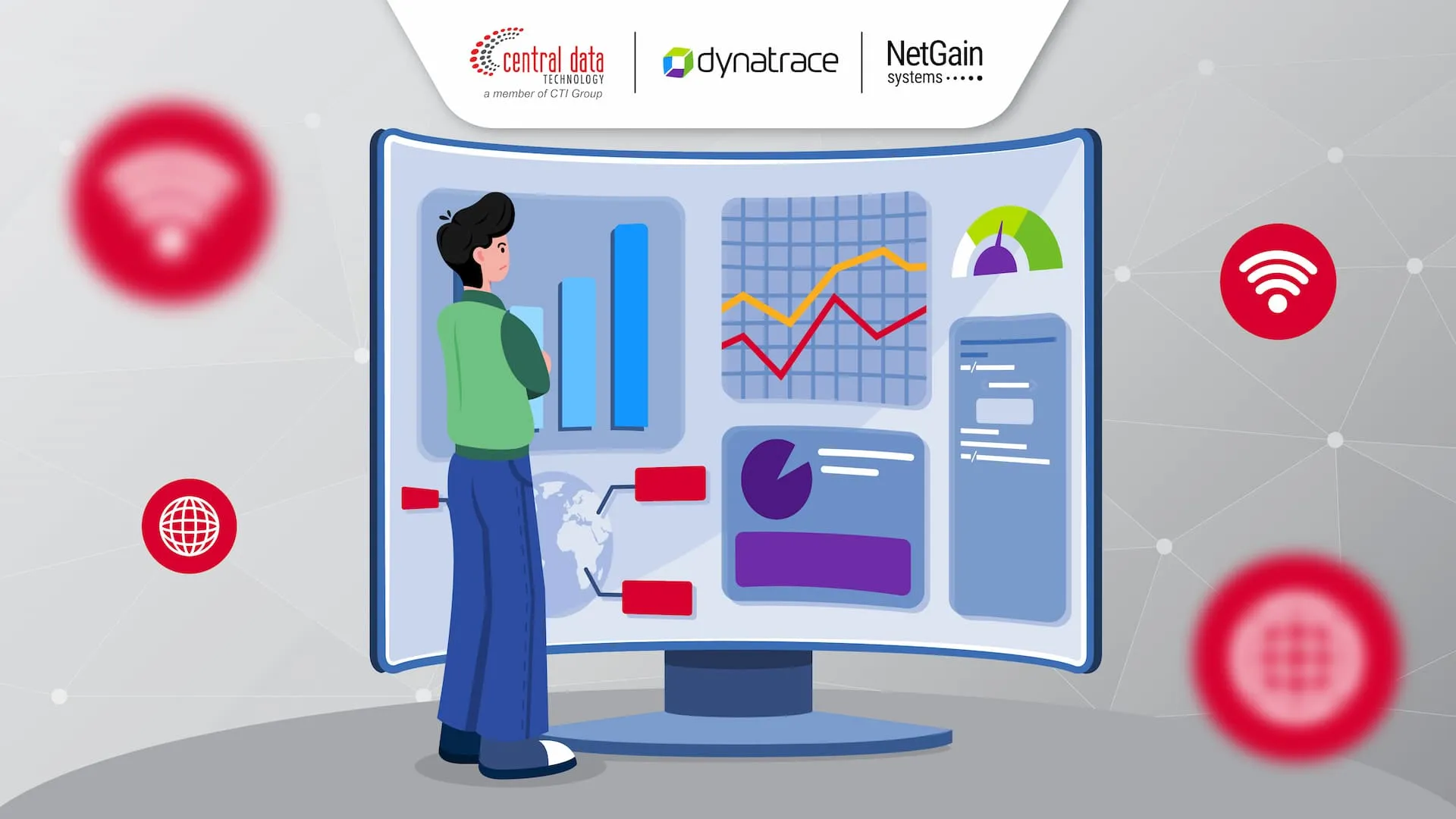
Through integration with platforms like Cerebro, NetGain Systems allows organizations to manage massive IoT fleets via a centralized, “single pane of glass” dashboard. This is particularly effective for large-scale deployments like Smart Cities, where countless interconnected systems, from traffic sensors to public safety nodes, must operate in perfect harmony.
Rather than building a monitoring infrastructure from scratch, organizations can leverage a ready-to-scale platform. NetGain consolidates data from disparate sources into real-time visualizations and automated alerts, reducing operational overhead while ensuring that the value of the IoT investment is realized immediately.
Synergizing AI-Powered Insights to Maximize IoT ROI
The true value of IoT isn’t measured by the number of devices deployed, but by the effectiveness of the data they produce. This is where the synergy between NetGain Systems and Dynatrace becomes a game-changer for ROI.
Through the strategic approach provided by Central Data Technology (CDT), the infrastructure data captured by NetGain is fed into Dynatrace’s Davis® AI. This integration adds vital context to every signal. For instance, if a sensor fails to transmit data, the system can instantly determine if the fault lies within the hardware, a network congestion point identified by NetGain, or a cloud-side application error.
By automating this diagnostic process, the Mean Time to Repair (MTTR) is slashed from hours to seconds. This ensures that operations remain resilient, and that every dollar spent on IoT contributes to the bottom line.
Building a Resilient IoT Future with CDT
As we navigate the demands of 2026, the resilience of your IoT infrastructure will be a primary competitive differentiator. As an authorized distributor for both Dynatrace and NetGain Systems, Central Data Technology (CDT), a subsidiary of CTI Group, serves as your strategic partner in architecting adaptive monitoring ecosystems.
Supported by a team of veteran experts and a comprehensive solution portfolio, CDT is ready to ensure your digital transformation journey is secure, measurable, and future-proof.
Secure your IoT foundation today. Discover how this strategy can fortify your business by consulting with CDT’s expert team through this link.
Author: Wilsa Azmalia Putri – Content Writer CTI Group