The conversation around AI in the enterprise world has evolved significantly over the past few years.
Organizations are no longer asking whether they should adopt AI. Instead, the focus has shifted toward a more practical question: how can AI move beyond assisting employees and begin executing tasks, managing workflows, and supporting business operations with minimal human intervention?
This shift is driving the rise of Agentic AI. Rather than simply responding to prompts, AI is increasingly being designed to understand objectives, make decisions based on context, and carry out actions autonomously.
For enterprises, this opens the door to a new operational model: Autonomous IT, an environment where systems can proactively monitor, optimize, and respond to changing conditions with greater speed and efficiency.
What Is Agentic AI?
Agentic AI refers to AI systems that can operate with a higher degree of autonomy to achieve specific goals.
Unlike traditional AI applications that require continuous instructions, Agentic AI can break down objectives into multiple steps, execute actions independently, evaluate outcomes, and adapt its approach as circumstances change.
This allows AI to move beyond being a tool that supports human decision-making and become an active participant in executing business and IT processes.
Agentic AI vs. Generative AI: What’s the Difference?
Generative AI has introduced many organizations to the practical benefits of AI. From content creation to conversational assistants, these systems help users generate outputs based on prompts and requests.
However, their role is largely reactive. Agentic AI takes a different approach.
Instead of waiting for instructions at every stage, AI agents can pursue defined objectives, interact with multiple systems, retrieve information, make contextual decisions, and perform tasks across a workflow with limited human involvement.
In simple terms, generative AI helps people complete tasks, while Agentic AI is designed to take a more active role in planning and executing those tasks with limited human intervention.
Why Enterprises Are Exploring Agentic AI
As business operations become increasingly complex, organizations are under constant pressure to improve efficiency, accelerate decision-making, and optimize resources without continuously expanding teams or operational overhead.
Agentic AI offers a compelling opportunity to address these challenges by enabling organizations to:
- Automate multi-step business processes
- Accelerate decision-making with real-time insights
- Reduce repetitive and manual workloads
- Improve operational consistency and reliability
- Allow IT teams to focus on strategic initiatives instead of routine administrative tasks
Potential use cases span a wide range of functions, including customer service, IT operations, incident management, cybersecurity, infrastructure monitoring, and data-driven business processes.
Key Challenges of Agentic AI Adoption
While the benefits are significant, successful Agentic AI implementation requires more than selecting the right AI model. Enterprises must also address several foundational challenges.
Infrastructure Readiness
Autonomous AI agents consume significantly more computing resources, storage, and data bandwidth than traditional applications. As the number of AI-driven processes grows, organizations need infrastructure that can scale efficiently without compromising performance.
Data Readiness
AI agents are only as effective as the data they can access. Fragmented, outdated, or inconsistent data can limit their ability to make accurate decisions and deliver meaningful outcomes.
Integration with Existing Systems
Most enterprises operate within a complex ecosystem of applications, databases, and legacy systems. To unlock the full value of Agentic AI, organizations need seamless integration between AI agents and their existing technology stack.
Security and Governance
As AI systems gain more autonomy, governance becomes increasingly important. Organizations must ensure that AI activities remain transparent, auditable, and aligned with internal policies, industry standards, and evolving data privacy regulations.
Building Enterprise-Ready AI Agents with Amazon Bedrock
One of the biggest challenges in Agentic AI adoption is creating an environment where AI agents can be developed, deployed, and managed securely at scale.
Amazon Bedrock helps address this challenge by providing a unified platform for building and running generative AI applications and AI agents without the operational burden of managing complex AI infrastructure.
Organizations can access a broad selection of foundation models through a single platform, allowing teams to choose the models that best fit specific use cases while maintaining flexibility as AI technologies continue to evolve.
This approach helps accelerate AI development while reducing the complexity often associated with enterprise-scale AI deployments.
From a security perspective, Amazon Bedrock also provides enterprise-grade controls such as encryption, identity-based access management, audit logging, and configurable guardrails that help organizations maintain governance and compliance requirements.
Click to Explore AWS Services on Central Data Technology.
Enabling Autonomous IT Visibility with NetGain Systems Astra AI
Building AI agents is only one part of the Autonomous IT journey. As organizations introduce more automation and AI-driven processes, maintaining visibility across the underlying infrastructure becomes increasingly important. This is where AI-powered observability plays a critical role.
NetGain Systems Astra AI transforms infrastructure data into actionable operational intelligence in real time. By analyzing information across servers, networks, applications, and security environments, Astra AI helps IT teams identify anomalies before they escalate into business-impacting incidents.
Rather than simply generating alerts, the platform provides contextual insights and recommended actions, helping teams troubleshoot faster and make more informed operational decisions. This enables organizations to move from reactive monitoring toward a more proactive and intelligent approach to IT operations.
Click to Explore NetGain Systems on Central Data Technology.
Building a Data Foundation for AI with TiDB
Alongside AI platforms and observability solutions, Agentic AI also depends on a data infrastructure capable of delivering timely, accurate, and consistent information.
Without real-time access to trusted data, AI agents cannot make effective decisions.
TiDB is a distributed SQL database designed to support modern applications, transactional workloads, analytics, and AI-driven environments within a single platform.
One of its key strengths is the ability to process operational transactions and analytical queries simultaneously, allowing organizations to gain insights from current data without introducing additional complexity into their architecture.
Its scalable design also helps enterprises accommodate growing data volumes and expand AI workloads while maintaining performance and operational flexibility.
Creating an Integrated Foundation for Autonomous IT
Autonomous IT cannot be achieved through a single technology platform.
Organizations need a connected ecosystem that brings together AI capabilities, operational intelligence, security, and data infrastructure into a cohesive architecture that supports long-term business objectives.
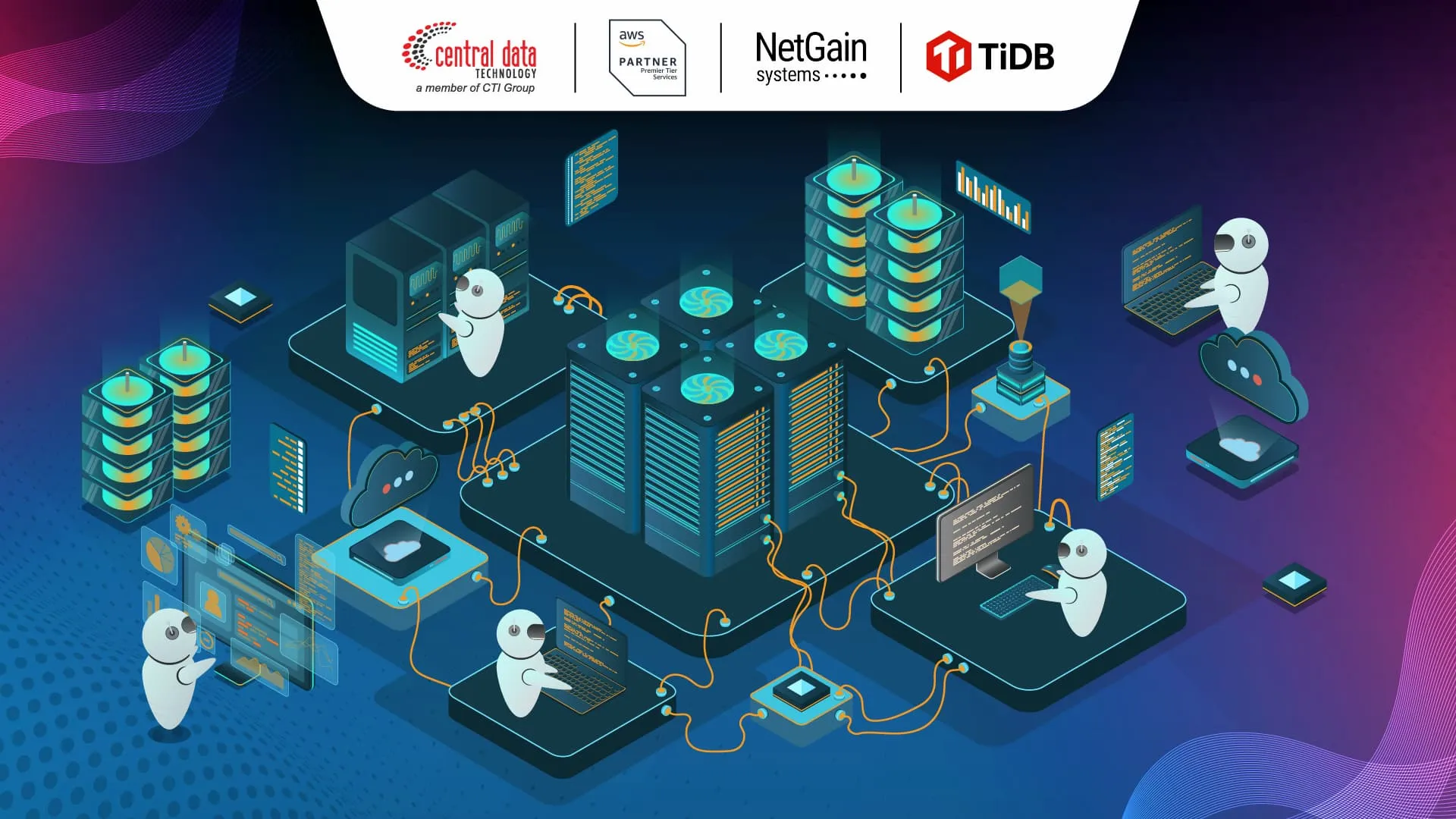
Amazon Bedrock provides the foundation for building generative AI applications and AI-powered agents at enterprise scale. NetGain Systems Astra AI delivers operational visibility and actionable insights. TiDB supports the data layer that enables real-time decision-making and scalable AI workloads.
Together, these technologies help enterprises establish a stronger foundation for adopting Agentic AI and advancing toward a more intelligent, resilient, and autonomous IT environment.
How CDT Helps Organizations Adopt Agentic AI
Every organization begins its AI journey from a different starting point. Before selecting technologies, enterprises need a clear understanding of their business objectives, infrastructure readiness, data maturity, and operational requirements.
Central Data Technology (CDT), part of CTI Group, helps organizations evaluate these factors through a consultative approach that includes assessments, architecture design, implementation planning, integration, and ongoing operational support.
By bringing together proven enterprise technologies and integration expertise, CDT helps organizations accelerate Agentic AI adoption while ensuring that investments deliver measurable business value.
Interested in evaluating your organization’s readiness for Agentic AI? Click on this link below and connect with our team to discuss the right strategy for your Autonomous IT journey.
Author: Wilsa Azmalia Putri – Content Writer CTI Group