In 2026, enterprise data no longer lives solely inside company servers protected by firewalls. Today, sensitive information moves across cloud storage platforms, SaaS applications, hybrid work devices, and even public AI tools employees use in their day-to-day activities.
Business files can move from Google Drive to a personal laptop, get shared through collaboration platforms, and eventually be processed through AI tools like ChatGPT or Microsoft Copilot, sometimes without the security team even realizing it.
In this environment, the challenge is no longer just about securing the corporate network. The bigger question is how organizations can consistently protect sensitive data regardless of where it resides, how it moves, or who accesses it.
As hybrid work and multi-cloud adoption continue to expand, traditional perimeter-based security models are becoming increasingly difficult to rely on as the primary layer of enterprise data protection.
Why Traditional Security Models Struggle in Hybrid Environments
For years, enterprise security strategies were built around a simple assumption: users and data operated inside a clearly defined corporate perimeter. Firewalls, VPNs, and traditional on-premises security solutions were designed to protect access from outside threats.
While these technologies still play an important role, modern data environments are far more decentralized than before. Enterprise data is now spread across SaaS applications, cloud platforms, BYOD devices, and constantly changing remote work environments. As a result, security blind spots are becoming more difficult to control using traditional approaches alone.
One growing concern for enterprises is the rise of Shadow AI, the use of public AI platforms by employees without proper governance or security oversight. This can happen when financial reports, internal contracts, customer records, or other sensitive documents are uploaded into generative AI tools for summarization, editing, or analysis without fully considering the risk of data exposure.
For organizations operating under data privacy regulations, these scenarios can create serious compliance and legal risks, even when the exposure happens unintentionally.
Traditional Data Security vs Zero Trust Data Security
Many traditional Data Loss Prevention (DLP) solutions were designed for centralized and relatively static IT environments. As enterprise data increasingly moves across cloud platforms, endpoints, SaaS applications, and personal devices, the limitations of legacy security models become more visible.
| Dimension | Traditional Data Security | Zero Trust Data Security |
| Access to Sensitive Data | Broad access once users enter the network | Least-privileged access based on user needs |
| Security Approach | Static and perimeter-based | Dynamic with continuous verification |
| Data Visibility | Limited visibility that creates blind spots | Deep visibility across cloud, SaaS, endpoints, and BYOD |
| Encrypted Traffic Inspection | Limited inspection coverage | Real-time inspection including TLS/SSL traffic |
| Threat Detection | Reactive and perimeter-dependent | Continuous monitoring and contextual analysis |
| Scalability | Dependent on on-premises infrastructure capacity | Cloud-native and scalable for hybrid enterprise environments |
The key difference with Zero Trust Data Security is not simply adding more security features. It represents a shift in how organizations approach data protection itself, focusing on securing data consistently across the entire enterprise environment instead of relying solely on network boundaries.
Simplifying DLP Operations with AI-Powered Data Discovery
One of the biggest challenges with traditional DLP implementations is the long-term complexity of managing policies and configurations.
Security teams often need to create and maintain numerous manual rules to identify different types of sensitive information, ranging from customer data and financial documents to personally identifiable information (PII). This process can be time-consuming, resource-intensive, and prone to generating large volumes of false positives.
With AI-Powered Data Discovery, Zscaler helps simplify this process by automatically discovering, classifying, and monitoring sensitive data across cloud and enterprise environments. This approach improves data visibility without forcing security teams to manage highly complex manual detection patterns and policies.
AI-driven contextual analysis also helps improve alert relevance, allowing security teams to focus on incidents that genuinely require attention instead of spending time filtering excessive alerts.
Unified DLP: One Policy Across Every Data Channel
Modern data security challenges are often caused by fragmented tools and disconnected policies. Many organizations still manage email protection, endpoint security, SaaS visibility, and cloud storage monitoring through separate platforms.
Over time, this creates inconsistent policies and additional security blind spots across the enterprise environment.
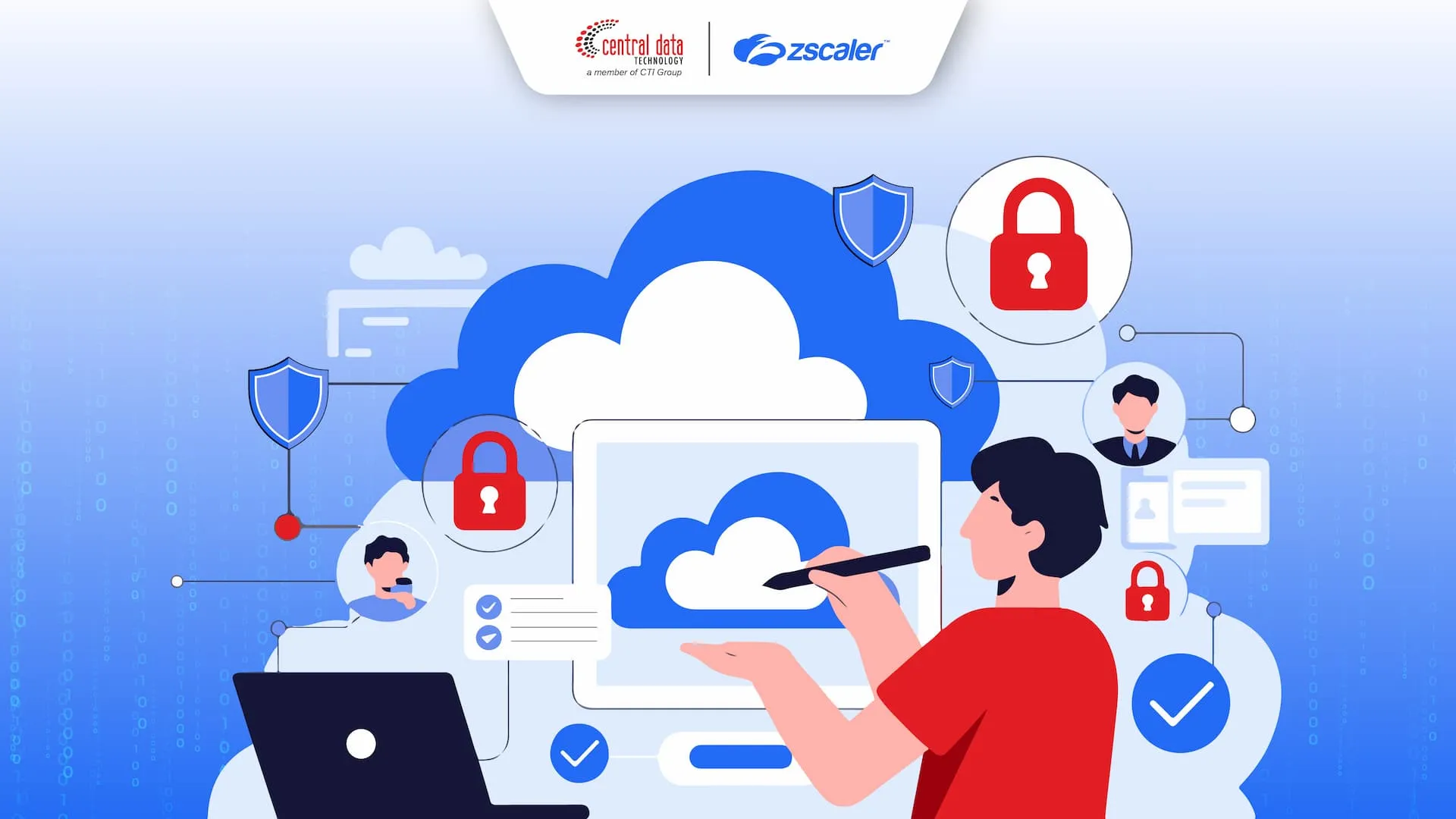
Through the Zscaler Zero Trust Exchange platform, organizations can implement a Unified DLP approach where a single security policy applies consistently across multiple environments and data channels.
The same policy can protect company email, managed endpoints, SaaS applications such as Google Workspace and Salesforce, cloud storage platforms, and even BYOD devices used by employees to access company resources.
Integration with CASB (Cloud Access Security Broker), Endpoint DLP, and email protection capabilities also help organizations centralize visibility and control without managing multiple disconnected security policies. This unified approach not only simplifies security operations but also helps reduce blind spots across hybrid and multi-cloud environments.
Improving Detection Accuracy with EDM, IDM, and OCR
In addition to AI-based data classification, Zscaler also provides several advanced protection mechanisms for enterprises that require more granular control over sensitive information.
Exact Data Match (EDM) enables organizations to protect highly specific data such as identification numbers, customer records, or financial information with greater precision.
Indexed Document Matching (IDM) helps detect sensitive documents based on templates or document content, even when files have been partially modified before being shared externally.
Meanwhile, Optical Character Recognition (OCR) helps close another often-overlooked security gap: sensitive information hidden inside images or screenshots.
In modern workplaces, screenshots are one of the easiest ways to move information outside the organization. With OCR capabilities, enterprises gain better visibility into potential data leakage attempts that conventional DLP approaches may struggle to detect.
Build a More Integrated Data Security Strategy with CDT
Protecting enterprise data in today’s hybrid environment requires more than simply deploying additional security tools. Organizations need an integrated strategy that combines visibility, policy enforcement, and consistent protection across modern data environments.
Central Data Technology (CDT), part of CTI Group, helps organizations design and implement Zero Trust-based Unified DLP strategies powered by Zscaler solutions.
From architecture planning and security assessments to full integration with existing security ecosystems, CDT supports enterprises in building scalable and modern data protection strategies that align with today’s hybrid business environments.
Discuss your organization’s data security requirements with the CDT team and discover how Unified Cloud DLP can help protect enterprise data more consistently across every digital channel.
Author: Wilsa Azmalia Putri – Content Writer CTI Group