For years, Multi-Factor Authentication (MFA) has been considered one of the most effective ways to protect user accounts from cyberattacks. Adding a second layer of verification beyond usernames and passwords significantly reduced the risk of unauthorized access and became a fundamental component of enterprise security.
However, today's threat landscape has changed.
Cybercriminals are no longer focused solely on stealing passwords. Increasingly, they exploit users through phishing campaigns, MFA fatigue attacks, and other forms of social engineering designed to bypass traditional authentication methods. As a result, compromised credentials continue to be one of the leading causes of security incidents across organizations worldwide.
This shift is reshaping how businesses approach identity security. Rather than relying solely on conventional MFA, organizations are adopting phishing-resistant authentication—a new generation of identity protection designed to defend against attacks that traditional verification methods can no longer stop.
Why Traditional MFA Is No Longer Enough
Most MFA deployments today rely on a combination of passwords and one-time passcodes (OTPs) delivered through SMS, email, or authenticator applications. Compared to password-only authentication, this approach provides a significant improvement in account security. However, it is not immune to modern attack techniques.
One-time passcodes can still be intercepted through man-in-the-middle (MitM) attacks, while SMS-based authentication remains vulnerable to SIM swapping, where attackers take control of a victim's mobile number to receive verification codes. Even push notifications, often viewed as a more convenient authentication method, can be exploited through MFA fatigue or prompt bombing, overwhelming users with repeated approval requests until they unknowingly authorize a malicious login.
The challenge isn't that MFA has become ineffective. Rather, many traditional authentication methods still rely on users making the right security decisions at the right moment. When attackers successfully manipulate users through phishing or other social engineering techniques, that additional authentication layer can quickly lose its effectiveness.
This challenge is becoming even more significant as credential theft continues to rise globally. Billions of compromised usernames and passwords circulate through underground marketplaces every year, while many organizations still rely on authentication strategies that were designed for a very different threat of landscape. As identity-based attacks continue to evolve, businesses need authentication methods that can better withstand today's increasingly sophisticated phishing techniques.
Phishing-Resistant MFA: The Next Evolution of Identity Security
Rather than relying on verification codes that can be intercepted, stolen, or manipulated, phishing-resistant MFA uses authentication methods that are cryptographically bound to the user, their device, and the legitimate application they are accessing.
This approach leverages technologies such as FIDO2 security keys, passkeys, digital certificates, and biometric authentication backed by cryptographic credentials. Because authentication is tied to the legitimate domain and verified application, attackers cannot simply trick users into entering credentials on a fake website or replay authentication data elsewhere.
This represents a fundamental shift in how identity is protected. Instead of depending on users to recognize phishing attempts or avoid social engineering attacks, phishing-resistant authentication is designed to make those attacks technically ineffective from the outset.
As organizations continue adopting cloud services, hybrid work models, and digital-first operations, phishing-resistant MFA is rapidly becoming the preferred standard for protecting corporate identities, particularly for businesses that manage sensitive customer information, financial transactions, or other high-value digital assets.
Strengthening Identity Security While Supporting Regulatory Compliance
In Indonesia, the need for stronger authentication also aligns with the implementation of the Personal Data Protection Law (UU PDP), which requires organizations handling personal data to implement appropriate technical and organizational safeguards against unauthorized access, misuse, and disclosure.
Strong access controls, including robust authentication mechanisms, play an essential role in meeting these obligations, as many data breaches originate from compromised user credentials rather than vulnerabilities in the underlying infrastructure.
By implementing MFA, particularly phishing-resistant authentication, organizations not only strengthen their identity security posture but also demonstrate that appropriate access controls are in place as part of a broader data protection strategy. Authentication policies, access logs, and identity governance practices all contribute to a more structured and auditable security framework.
Ultimately, investing in modern identity security is no longer just an IT initiative. It has become an important component of regulatory compliance, corporate governance, and long-term business resilience.
Context-Aware Authentication: Making Access Decisions Based on Risk
Verifying a user's identity is an essential first step, but identity alone does not always determine whether an access request should be trusted. Modern organizations also need to evaluate the context surrounding every authentication attempt.
This is where context-aware authentication, often referred to as adaptive authentication, becomes an important part of a modern identity security strategy.
Rather than treating every login to the same, context-aware authentication evaluates multiple risk signals before granting access. These signals may include the user's geographic location, device type, login time, network environment, and even behavioral patterns established through previous activity.
When an authentication request appears consistent with a user's normal behavior, such as logging in from a recognized device at a familiar location, the system can allow access with minimal friction. However, if the request originates from an unfamiliar country, an unregistered device, or exhibits unusual behavior, additional verification can be required automatically before access is granted.
This risk-based approach closely aligns with Zero Trust, where no access request is automatically considered trustworthy simply because a user has successfully authenticated. Every request is evaluated based on identity, context, and risk, allowing organizations to strengthen security while maintaining a seamless experience for legitimate users.
When combined with phishing-resistant MFA, context-aware authentication creates a far more adaptive identity security framework, one that responds intelligently to changing risk without unnecessarily disrupting day-to-day business operations.
Building an Integrated Enterprise Identity Security Architecture
Modern identity security requires more than deploying a single authentication product. Organizations need an integrated architecture that can manage user identities, secure access to business applications, and apply authentication policies consistently across increasingly complex IT environments.
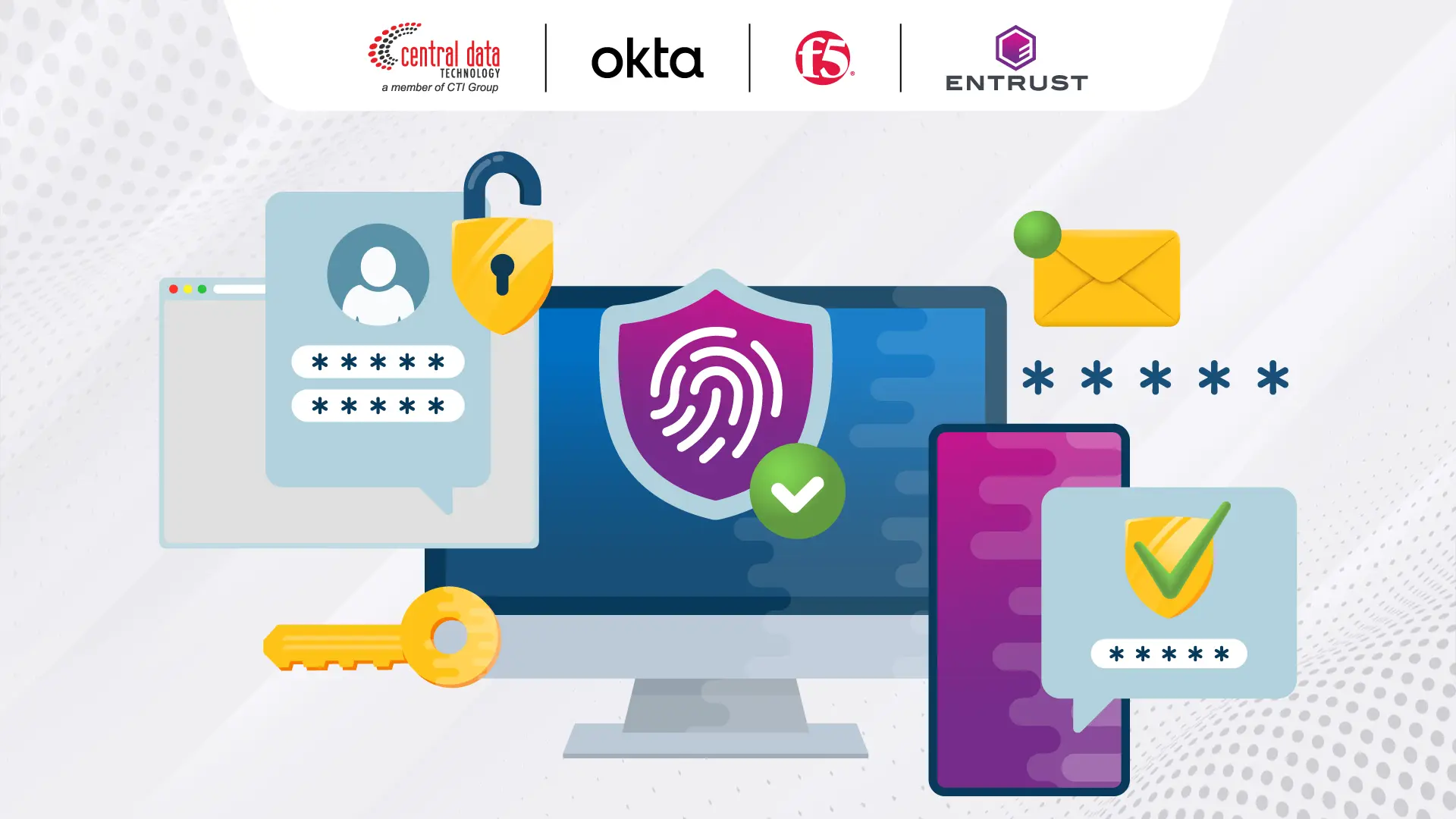
This is where solutions such as Okta, F5 BIG-IP Access Policy Manager (APM), and Entrust play complementary roles within a broader identity security ecosystem.
As an Identity and Access Management (IAM) platform, Okta helps organizations centralize identity management, implement adaptive Multi-Factor Authentication, and enforce risk-based authentication policies across cloud and on-premises applications. It also supports modern authentication standards, including passwordless authentication through FIDO2.
F5 BIG-IP APM extends these capabilities by acting as an Identity-Aware Proxy, providing secure access to enterprise applications regardless of where they are hosted. Whether applications reside in traditional data centers, hybrid environments, or the cloud, BIG-IP APM enables organizations to apply consistent access policies, perform step-up authentication for sensitive applications, and integrate with identity providers such as Okta.
Complementing these capabilities, Entrust provides a broad range of authentication technologies, including digital certificates, hardware security keys, biometric authentication, and other phishing-resistant credentials. These solutions help organizations strengthen user verification while supporting broader Zero Trust initiatives.
Together, these technologies enable organizations to build a comprehensive identity security architecture, one that protects users from initial authentication through ongoing access to critical business applications and digital resources.
Read More: Discover AIOps: The Smart Solution to Simplify IT Operations
Strengthen Your Identity Security Strategy with CDT
Identity has become the new security perimeter. As phishing attacks, credential theft, and other identity-based threats continue to evolve, organizations can no longer rely on passwords or even traditional MFA alone to protect access to critical systems and sensitive data.
Building a modern identity security strategy requires more than adding another authentication factor. It means adopting an architecture that continuously verifies identities, evaluates access requests based on context and risk, and applies security policies consistently across users, devices, and applications.
As an authorized partner of Okta, F5, and Entrust in Indonesia, Central Data Technology (CDT), part of CTI Group, helps organizations design and implement identity security solutions that align with their business objectives, regulatory requirements, and existing IT environments. From identity assessment and solution design to deployment and ongoing support, CDT works with organizations to build a stronger foundation for secure digital access.
Contact CDT today to learn how enterprise identity security solutions can help your organization strengthen cyber resilience while supporting a modern Zero Trust strategy.
Author: Wilsa Azmalia Putri – Content Writer CTI Group