Digital transformation is driving organizations across every industry to adopt hybrid cloud as a core operational model. The increased flexibility of hybrid cloud allows businesses to run workloads across a combination of public cloud, private cloud, and on premises infrastructure. At the same time, this model significantly expands the attack surface and demands stronger, more comprehensive protection.
Misconfigurations, weak identity controls, and limited visibility across environments remain some of the most common causes of cloud security incidents. This is why organizations need a mature hybrid cloud security approach that prepares them to manage the risks of data breaches and service disruptions that can directly affect business reputation and continuity.
What is Hybrid Cloud and Why Does Security Matters?
Hybrid cloud is an IT architecture that integrates public cloud, private cloud, and on premises environments so they can work together and share data seamlessly. This model enables organizations to achieve flexibility, scalability, and cost efficiency while keeping control over critical systems and sensitive data.
However, hybrid cloud also introduces a higher level of security complexity. Data and applications continuously move between environments with different security characteristics and controls.
As a result, organizations need an integrated hybrid cloud security strategy to eliminate blind spots that attackers often exploit as entry points into enterprise systems.
Core Components of Hybrid Cloud Security: Identity, Data, and Infrastructure

Hybrid cloud security is built on three tightly connected components that cannot be separated: identity, data, and infrastructure.
Identity has become the new perimeter in modern architectures. Every user, application, and service must be strictly verified before accessing any organizational resource.
Data is the most asset and must be protected at every stage, whether it is stored, processed, or transferred between cloud and on premises environments.
Infrastructure includes servers, cloud workloads, networks, and APIs that require continuous monitoring to prevent security gaps caused by misconfigurations or undetected vulnerabilities.
Challenges in Securing Hybrid Cloud: Common Obstacles and Risks
Securing a hybrid cloud environment is not without challenges. Many organizations struggle with limited visibility due to fragmented security tools deployed across different environments.
The use of multiple, disconnected security solutions also increases operational complexity and slows incident response. Other common risks include lateral attacker movement, misuse of privileged credentials, API based attacks, and unintentional exposure of applications.
Business Benefits of Effective Hybrid Cloud Security
A well-designed hybrid cloud security strategy delivers tangible business value. It helps reduce the risk of operational disruption, protects customer trust, and supports compliance with industry regulations.
Consistent security across all environments also enables organizations to move faster with digital innovation without compromising the protection of critical assets. Security decisions can be made based on more accurate and real time risk context.
Best Practices for Managing Hybrid Cloud Security
Key best practices for managing hybrid cloud security include implementing strong identity controls, maintaining unified visibility across environments, and using automation for incident detection and response.
Organizations should also adopt a risk-based approach, prioritize the most impactful security gaps and ensuring security policies are applied consistently across cloud and on premises platforms.
Read More: How Does Hybrid Cloud Networking Optimize Modern Business Operations?
Hybrid Cloud Security Solutions from Trusted Providers
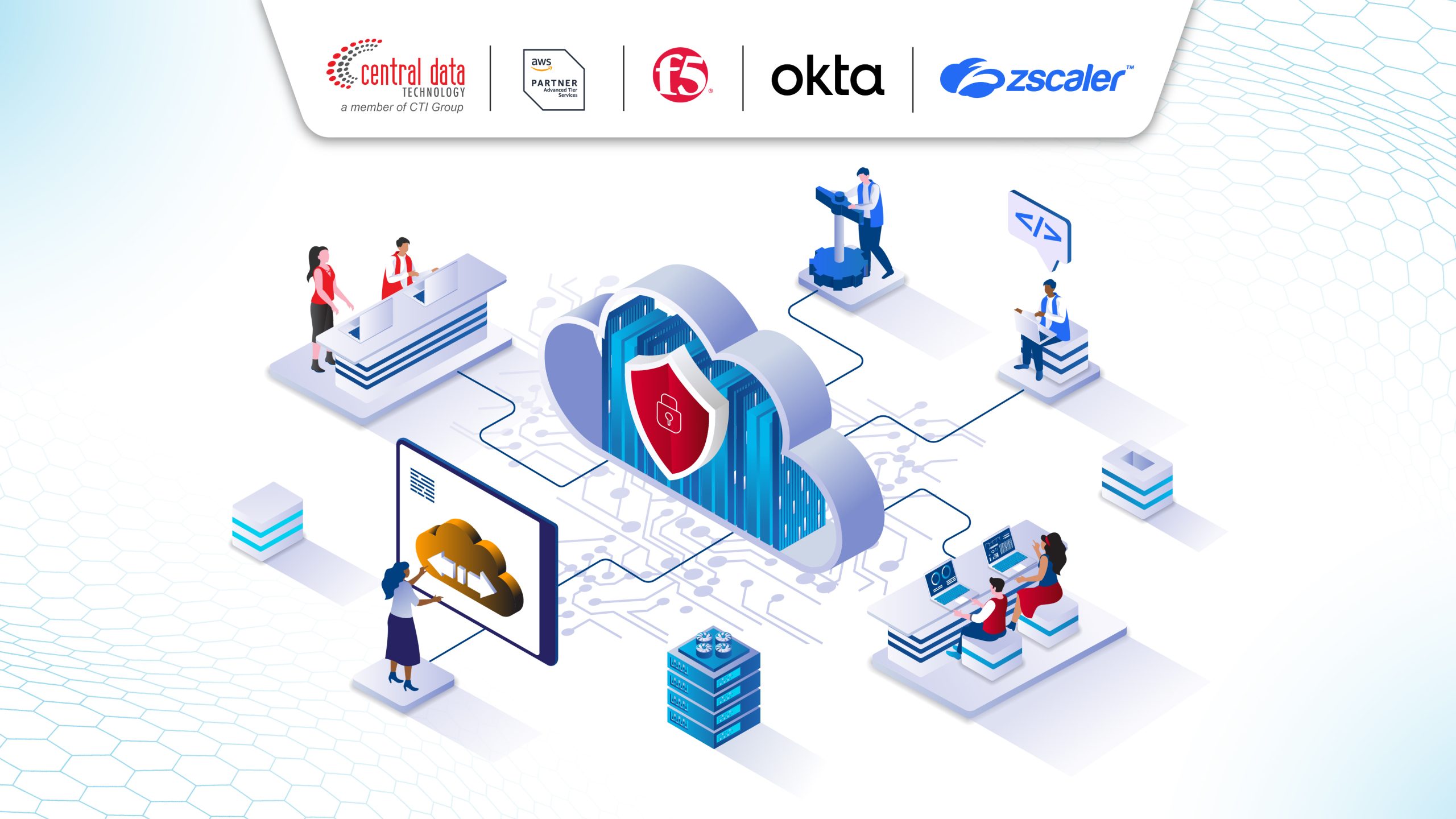
To address the complexity of hybrid cloud environments, many organizations rely on security solutions from trusted global providers. Central Data Technology offers a comprehensive portfolio of hybrid cloud security solutions from industry leaders such as AWS, F5, Okta, and ZScaler.
AWS Security Hub
AWS Security Hub helps organizations centralize cloud security visibility within a single platform by prioritizing critical issues and automating large scale responses. The solution unifies security operations through continuous monitoring, context-based risk correlation, and automated workflows that accelerate threat mitigation.
AWS Security Hub is designed to simplify security management by collecting, correlating, and enriching security signals from various AWS services and third-party solutions into actionable insights.
With centralized visibility across cloud environments, security teams can focus on the most critical issues. This solution automatically correlates security findings, enriches them with risk context, and delivers near real-time risk analytics with delays measured in seconds to minutes, enabling faster, more accurate decision-making.
In addition, AWS Security Hub enables continuous security monitoring through automated checks against industry standards and AWS best practices. When deviations are detected, teams can respond efficiently using automated workflows and native integrations with ticketing systems, allowing security operations to scale without increasing operational complexity.
F5
F5 Web App and API Protection is recognized as a Leader by KuppingerCole and delivers continuous protection for applications and APIs across hybrid and multicloud environments. With capabilities such as bot management, DDoS protection, continuous application scanning, zero-day vulnerability mitigation, and end to end API security, F5 helps organizations maintain consistent protection.
F5 enables continuous defense against threats that target critical business logic, not just infrastructure layers. The platform also supports innovation by allowing teams to accelerate application development and deployment without being burdened by complex manual security processes.
By applying consistent security wherever applications run, F5 helps organizations simplify operations and reduce complexity caused by tool sprawl. End to end visibility and consistent policy enforcement ensure that security remains aligned with business objectives and digital strategies.
Okta
Okta Privileged Access provides unified access and governance for privileged users across cloud and on premises environments. The solution improves visibility, compliance, and security without compromising user experience, making it a critical component of a hybrid cloud security strategy.
By eliminating static credentials such as SSH keys and passwords through Just In Time access, Okta significantly reduces the attack surface and the risk of credential theft. All privileged access sessions can be centrally recorded and audited, creating a strong audit trail that supports regulatory compliance and enhances transparency.
Fully integrated with the Okta identity platform, this solution delivers a single pane of control for managing privileged access. Security teams can enforce policies, monitor activity, and respond to threats more quickly while ensuring security scales alongside ongoing cloud adoption without sacrificing user experience.
Zscaler
Zscaler Private Access delivers a True Zero Trust approach that removes reliance on traditional network-based access methods such as VPN. Instead of granting network access, ZPA connects users directly to authorized applications, dramatically reducing the attack surface in hybrid cloud environments.
By keeping private applications invisible to the internet and allowing only outbound, application-based connections, ZPA minimizes exposure to network based attacks. This connection model also eliminates the risk of lateral movement that is common in traditional VPN architectures.
ZPA provides a secure and seamless access experience for remote workers, branch offices, and third-party partners without compromising performance. All context aware access policies and segmentation are supported by AI and orchestrated through the global Zscaler cloud, making security operations simpler, faster to deploy, and ready to scale with modern business needs.
Build a Secure and Trusted Hybrid Cloud Security Foundation with CDT
Hybrid cloud security has become a long-term strategy for protecting organizations in the digital era. The right approach enables businesses to secure identities, data, and applications without slowing growth or innovation.
Together with CDT, as part of CTI Group, your organization can design and implement a scalable hybrid cloud security strategy using technologies from AWS, F5, Okta, and Zscaler. Contact the CDT team today to build a secure, resilient cloud foundation that is ready to face future threats.
Author: Ervina Anggraini – Content Writer CTI Group